
You may wonder why Tasmania is covered on History for Hipsters… Is it the undebatable fact that Hobart is ranked as Australia’s #3 hipster city? Is it because Pond’s newest album is titled Tasmania? Or is it because of my semi-edgy, ironic statement that – haters gonna hate – Tassie is the most true blue part of Australia. Look, it’s got its own wicked history of European exploration, it was one of the earliest British settlements, and you could even say that it was Tasmanian colonists who founded Melbourne. (So, without Tasmania, no double shot espresso with almond milk.) Also, the Aussie phenomenon of bushrangers (escaped prisoners turning into rural criminals) kind of existed on mainland Australia, but… these stories were exaggerated later. On Van Diemen’s Land, however, bushranging was pretty much a lifestyle for real. And if Australia started as a convict society of unwanted prisoners… Well, for a while – its underbelly, the unwanted within Sydney’s convict society, were sent to Van Diemen’s Land. However, (and that’s what this article is about), the most important reason is that Australia is the continent of the Aboriginal civilisation. It’s the world’s oldest human civilisation and has been subjected to an inhumane amount of injustices after the British/European invasion. And nowhere more so than in Tasmania have the consequences of colonisation been as deeply destructive for Aboriginal societies…
In this article, I’ll start with the ones we are actually talking about: the Aborigines on trouwunna or lutrawita (two of the pre-colonial names for Tasmania) and their civilisation. The rest of the article goes through the events and phases that led to a rapid decline of trouwunna’s tribal societies. Not because we like it, but because we hate it: I’ll pay quite a lot of attention to the war against the Aborigines – often called The Black War, however called The Tasmanian War in this article. To end on a more positive note, I want to make clear here and now that Tasmanian Aborigines are not extinct. There are proud Aborigines on the island, and the Tasmanian Aboriginal Centre (TAC) is considered one of the most powerful Aboriginal organisations within Australia. trouwunna/lutrawita Tens of thousands of year ago, the Australian continent, which we can name Sahul, was a lot bigger. The sea level was low, so (what’s now) New Guinea, Australia and Tasmania were one connected landmass. About 65,000 years ago, humanity arrived. It took a year or two to spread over the entire continent. The peninsula in the south east (what we now call Tasmania) was inhabited around 35-40,000 years ago. The plains that connected the peninsula with the mainland were flooded around 10,000 years ago – turning into (what we call) the Bass Strait. Now, the island’s Aborigines were separated from their mainland relatives. Thousands of years later, one can say that the Aborigines living on trouwunna/lutrawita – as the island was called – still had a fundamental culture in common with the Australian Aborigines. This includes a following of the dreamtime: "a complex code for how life is to be lived, how food is to be gathered and how marriage, trade and disputes are to be regulated. It recognises that people are part of the land they inhabit and the land is part of the people. The Dreamtime fuses past, present and future with physical and spiritual worlds, leading Australia’s greatest anthropologist, W.E.H. Stanner, to sum it up beautifully as 'everywhen.'"DH Other cultural practices, like wedding ceremonies, developed differently on both sides of the Bass Strait. As you may expect, even among the different nations and clans on trouwunna/lutrawita there were varieties in traditions, for example a different use of spirit animals. For some tribes, eating male kangaroos or wallabies was taboo – for another, eating the females was a no-go. Spiritual ceremonies were practised with a belief that the good spirit (noiheener, or parledee) governed the day and the bad spirit (wrageowrapper) ruled during the night. Funeral ceremonies were also a big deal on trouwunna/lutrawita:
“When a person died, their relatives often decorated the body with ochre and clay, wrapped it in leaves with items from their totem such as bird feathers or animal skins and then cremated it, in a sitting position either on a specially prepared wooden platform or in the hollowed-out base of a tree, amid intense ceremonies to farewell them on their journey to join their relatives in the spirit world. A guardian spirit or ‘soul’ that lived within their left breast went to live elsewhere – such as the islands in the Bass Strait. After the body was cremated, female relatives might extract small bones from the charred remains, wrap them in kangaroo fur and use them as amulets to ward off evil spirits of harm and illness.”LR
I guess you can imagine that the Aborigines were a hunting people. The men had spears and waddies (a club, a hunting stick) to hunt for wallabies, possums and kangaroos. In areas near the coast or rivers, men and women went swimming to hunt for seafood. The people were nomadic, although all over the island, different types of huts were found, used as shelter for wind and rain. “They had even got around to inventing the door, which would have thrown a serious spike into the wheels of Terra Nullius had the British taken any interest in Tasmanian architecture.”DH There was a division of gender roles: men hunted, women did craftwork with animal skin or made baskets. Perhaps unexpectedly, children weren’t brought up by their mothers only – fathers were tender, attentive and guiding as well. Concerning their love life – the Aborigines on trouwunna/lutrawita had monogamous relationships. There was a concept of marriage (I assume with a wedding ceremony) and people often married in their late teens. Remarrying after a partner had died was common. The norm was exogamous, which means the wife moved to her husband’s clan, although the opposite happened as well. Sometimes, there were parental objections for marriages that were considered wrong, and there were punishments for cheating. The concept of divorce did exist, but was not a reason for any violence between the clans. Having said this, infidelity and jealousy sometimes led to violence, and raids on other clans for the purpose of kidnapping women sometimes occurred. Around the year 1800, right before colonisation took off, there were about 7000 people on trouwunna/lutrawita, although this number is also subject to debate. Like most other hunter and forager civilisations, they appear to have operated in a social system of three units: the domestic unit (family), the basic social unit (clan) and the political unit (nation). It seems that there were nine nations and four major languages in trouwunna/lutrawita. The existence of multiple languages and absence of written records makes determining the names of clans and geographical points complicated. This is why the island of Tasmania is named trouwunna (or: trowunna) as well as lutrawita (or: lutrawitter) in the native languages. In this article I’ll use both, without a capital letter, when I talk about the island before its colonisation – or (try to) write from a viewpoint of tribal Aborigines. Nowadays, all topo- and geographical names are known in English rather than their original names.
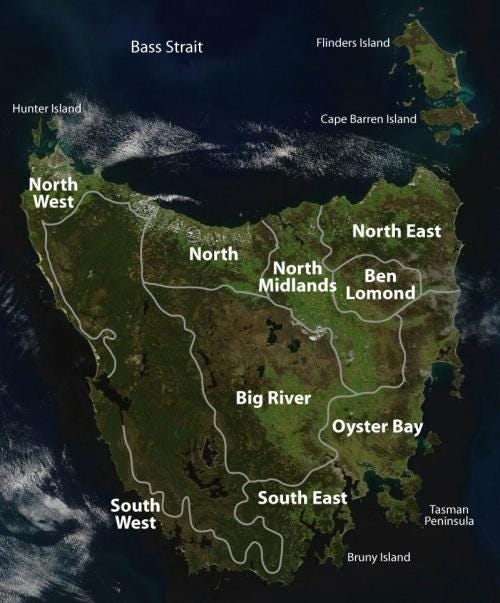
Nations of Tasmania
On trouwunna, the west coast is considered the most remote. The landscape is mostly hilly and forested. It’s hit by strong winds from the Roaring Forties, bringing in loads of rain too – but hey, let’s not chitchat about the weather too much. The centre of the island is the most mountainous. Even these wild parts of trouwunna were inhabited by nations and clans, albeit more sparsely. It is somewhat difficult to comprehend which territory was occupied by which nation – although names like ‘North East nation’ and ‘South West nation’ offer a clue. Sure, but what I’m trying to say is, it’s hard to more deeply understand why, in a political way. The North Midlands nation stood in contact with many other nations, since they lived by the largest hunting fields for kangaroos around (what’s now called) Campbell Town and Launceston. The Ben Lomond nation occupied the high plain, now known as... the Ben Lomond National Park. The Big River nation lived at a territory in the central area of the island, also in the highest areas. Upon colonisation, the most populous nation was the Oyster Bay nation – whose clans more or less lived on the east coast from (what’s now) Scamander ranging up to Hobart. Precious ochre mines were found in the territory of the North nation – of great importance in a society where ochre was used for decoration and funeral ceremonies. The clans and nations moved around the island – up to a certain degree. The nation had a clear sense of what was (and was not) their territory. In fact, their land was at the heart of their identity. Entering another nation’s territory was possible after asking for permission. If no permission was granted, crossing the border was occasionally a reason for conflict. Still, it could be possible for a family to spend winter with clans from the Oyster Bay nation – and the summer on the Ben Lomond highland. For example, in the early spring the clans moved to river mouths near the coast – the place where ducks and swans laid their eggs. Clans from the central, landlocked Big River nation even had access to both coasts.
So, life on trouwunna was tough but the civilisation was functioning – as it had for many thousands of years. The Aborigines had several languages, there was food, a spiritual life and cultural celebrations. The people lived by the annual rhythm of seasons that they understood. Sure, there was hardship, conflict and violence as well – but if the people had been left undisturbed, life on trouwunna would have carried on just fine.
Explorers, seal hunters and colonists
The first Europeans to land on lutrawita were the fleet of Abel Tasman. In 1642, he named the island Van Diemen’s Land after his employer and claimed it for the Dutch state. The fleet went ashore but did not interact with people. It’s said that after looking at the marks on tree trunks the Dutchmen concluded that the island was inhabited by a race of giants, which might explain why it took 130 years for the next Europeans to have a closer look. That’s when Marc-Joseph Marionne du Fresne and his men arrived. They exchanged gifts with the natives, on (what’s now) Bruny Island. With two French boats ashore, things seemed fine. When a third boat came closer, the situation turned hostile. The islanders threw spears and stones, wounding the captain in command. When the French team, back on their boats, were attacked from a distance – they fired at the Aborigines, killing one and wounding several. French explorers wouldn’t see the island for the next twenty years. The expeditions by Bruni d’Entrecasteaux (1792 and 1793) and his crew seemed most friendly. Jaques Labillardière, the first botanist on the island, was overwhelmed by the beauty of the ancient forests. Jean Piron, an artist, showed empathy for Aborigines by portraying moments, such as the people preparing a meal, peacefully interacting to Europeans and hunting for fish. Piron’s drawings included “ingeniously woven” baskets, water carriers out of seaweed and the usage of kangaroo skin. On top of that, several Aborigine men were portrayed showing affection for their children. There are strong hints that stories about the visits by these Frenchmen reached all clans of the island.
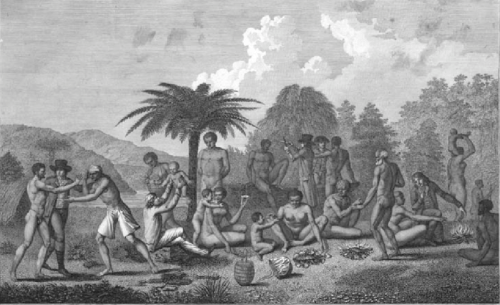
Jean Piron's drawing
In the same decade (1790s) a clock started ticking on trouwunna – slowly, but dramatically. For this, we actually have to go back some years more. In 1770, James Cook claimed the entire east coast of New Holland (what’s now Australia) as Terra Nullius, which meant uninhabited land – and therefore up for grabs. After planting the Union Jack, Cook and the British authorities thought it was now territory of the British crown. In 1788, governor Phillip started the settlement of Sydney. According to international law, the British crown could now have more or less claimed the area up until the Blue Mountains – but the colonists claimed the entire east coast, believing Van Diemen’s Land was connected. A few years later, the ruling governor allowed seafarers to hunt whales and seals. Whaling stations on the Australian south coast and at the Bass Strait were popping up – with a breakthrough in 1797-8 and a peak as early as 1804. Popular-historian David Hunt gives an idea what that means:
“It was sealers and whalers who first pushed the boundaries of the frontier. These champions of the Georgian counterculture were the hippies of their era - albeit hard-drinking, sexist, violent, whale-spearing, seal-clubbing hippies whom you really wouldn’t want to drop a tab of acid with. And so, the seal rush was born. Surly sailors, antisocial psychopaths and escaped convicts made for Bass Strait to murder every fur seal, hair seal and elephant seal they could find. Elephant seals were stabbed in the heart so blood would not contaminate their blubber, their tongues sold to European gourmands. Adult fur and hair seals were lanced, their babies clubbed and their pelts sold in China, America and Britain. The sealers ate dead seal, wore dead seal, and their work tanning sealskin and boiling blubber meant everything stank of dead seal.”DH Thanks to Matthew Flinders’ and George Bass’ expedition (1798), the Sydney colonial government realised that the 200 kilometre-wide Bass Strait cut off Van Diemen’s Land (Tasmania) from New Holland (Australia). This meant that the British had no legitimate claim to Van Diemen’s Land. In times of war against France, the colonial government in Sydney was not comfortable with French explorers popping up every now and then. In late 1802, Governor King’s government in Sydney noticed French presence around Van Diemen’s Land. It was Nicolas Baudin and his team, exploring the area. What happened next might be too good to be true…
“Governor King ordered Charles Robbins to sail after the Frenchmen. Robbins caught up on King Island in Bass Strait. The French were minding their own business when Robbins rushed into their camp and hung the Union Jack from a gum tree. Discovering that he had no gunpowder, he asked to borrow some from the nonplussed French (who acquiesced with admirable sangfroid). Robbins then fired his gun three times and made a garbled proclamation of a possession of Van Diemen’s Land, a completely separate island. It was then he realised he’d hung the Union Jack upside down. Baudin tersely informed Robbins that he had 'no intention of annexing a country that is already inhabited' and sent governor King a letter to express he thought 'the childish ceremony was ridiculous.'"DH So (according to David Hunt) the British crown claimed Van Diemen’s Land from an offshore island. Anyway, what’s for sure: this happened some years after the (British, semi-outlawed) sealers and whalers were pirating the area. The claim was strongly motivated by the presence of the French, mistaken for competition, who were already more familiar with the islanders. The British colonisation started a fair 160 years after the Dutch explorers had mapped, named (and even claimed) the island. And most of all, the British arrived tens of thousands of years after its first people had populated it successfully. The British claim that Van Diemen’s Land was up for grabs was a downright lie from the start.
Invasion The first area in Van Diemen’s Land to be occupied by the British settlers in September 1803 was named Risdon Cove. It’s on the southeast side of the island, 7 kilometres up the river (what’s now) Derwent. Five months later, Lieutenant-Colonel David Collins was also allowed to settle on Van Diemen’s Land. He thought the Risdon settlement lacked access to fresh water and started Hobart Town a few kilometres closer to the river’s mouth. Collins, now governor of Van Diemen’s Land, had instructions from the London government to settle down peacefully. In fact, violence against the natives was strictly forbidden and should be punished. This was an important instruction which Collins failed to pass on to his fellow settlers… On the morning of 3 May 1804, the convict settler Edward White was working in a garden near the Risdon settlement when he saw a few hundred native men, women and children appear from the valley nearby. Lieutenant William Moore, who was in charge of Risdon at that moment, was scared by this sudden presence. Hostilities began at 11am. Confused and in shock, the native people retreated to the hill on the other side of Risdon Creek. At 2pm, a carronade was fired at the Aborigines. The soldiers, settlers and convicts fired their rifles, pistols and muskets in support. The number of Aborigine casualties remains unknown, but is estimated to be between three and “a great many.”
That was the summary. Now I think it is the right moment to go more into detail. What happened at Risdon Cove was the first clash between white settlers and trouwunna’s natives. It also brought a clash, a debate among historians on how to interpret the intentions behind the violence. For a better understanding, I have to take you to historical sources. There were two recorded eyewitnesses at the time, Lieutenant William Moore and (to a far lesser extent) Surgeon-Magistrate Jacob Mountgarrett. Later in 1830, an inquiry was held, in which the convict settler Edward White (the first man to notice the group) was extensively interviewed.
Some square historians, of which the most outspoken one is Keith Windschuttle, basically trust the story as told by governor Collins and Lieutenant Moore. In his official report to governor Collins, four days after the massacre, Moore said that the Big River people had been the aggressors. The settlers had not fired at them until they had “surrounded the camp”, he claimed, only admitting that two Aborigines were killed that day. The square historians forget that these officers had an interest in downplaying the massacre. After all, Collins should have passed on London’s highest instruction: to not use violence against Aborigines while settling on Van Diemen’s Land. At least, Collins should have obtained control over the Risdon settlement. Lieutenant Moore even turned the event into a battle: claiming that the settlers were surrounded by 500 to 600 natives who started their attack. He admitted to two Aborigine deaths, as a result of self-defence. Collins defended Moore, stating the Aborigines started the violence and the defenders believed that they were cannibals. (For fuck’s sake: let it be clear that the lutrawita natives were not cannibals.) Their lies had an effect; they both successfully escaped reprimand.
Conservative historian Windschuttle discredits the other eyewitness, Edward White, because he was a convict, something the squares haven’t forgotten 200 years later. Here, we have to disagree. I cannot figure out what offense White had on his record – but around 1800, it didn’t take much for an Irishman to be shipped to Van Diemen’s Land. If anyone should be discredited for their character, I think the Lieutenant would make a good choice. Lieutenant Moore was an officer of the corrupt Rum Corps with a terrible reputation. Risdon’s commander John Bowen, who was absent on the day of the massacre, described Moore as a “mutinous rascal.” Moore’s senior, Captain Anthony Fenn Kemp, also said that Moore had “committed an outrage” and had been drinking on the morning of the massacre, leading him to overreact to the Aborigines’ sudden appearance, and that he had been driven by “a brutal desire to see the n****** run.” Another reason why the square historians discredited Edward White as a source is the fact that his interview took place 27 years after the event. However, again – one has to disagree. At the time of the inquiry (1830) it would not have been a smart move for Edward White to think something up that would implicate the soldiers’ guilt and the Aborigines’ innocence, because at the time the war against Aborigines was in full swing. Contrary to what the society expected from him, proving the Aborigines’ innocence is pretty much exactly what Edward White did: “The natives did not threaten me: I was not afraid of them. The natives were never within 220 yards of the settlement. They did not attack the soldiers, they would not have molested them. They had no spears with them: only waddies - they were hunting.” White also brought the number of natives down to a maximum of 300.
There is much more to the debate, but I guess the point is made. Now, the uncritical acceptance of the officers’ side by some historians is not a coincidence. It deliberately follows a pattern that downplays, or even denies, violence against Aborigines – Australia wide. Time after time, their arguments have been defeated in academic debate. Unfortunately, it still finds an audience among the square, right wing part of society nowadays that won’t do right and give justice to Aborigine people and their cause – even if they know better.
And so, we know now that Lieutenant Moore started the violence. The hundreds of natives passing the Risdon settlement “were probably the Leenowwenne and the Pangerninghe clans from the Big River nation on their autumn migration to the east coast.”NC Another tragic fact is, we won’t ever have an exact number of casualties for the first massacre on Van Diemen’s Land. That’s painful, in a humanitarian way. It is hard to give an estimated number, let it be between three and 30. Historian Henry Reynolds (who is quite hip) uses this case to illustrate why, Australia-wide, it’s often hard to give a number of Aborigine casualties. The event at Risdon was a massacre – it was not an accident, it wouldn’t be an isolated incident, and it wasn’t a fair battle. Symbolically, I believe Risdon Cove is nowadays the right place to remember the loss of trouwunna’s civilisation. After the massacre at Risdon Cove, Collins told the settlers to live apart from lutrawita’s natives. The same year, there were already some more hostile interactions. The peaceful drawings from Jean Piron, with French explorers talking to Aborigines, were just over a decade old by that time. However, they were from another century – and not only literally…
Settlement and coexistence. 1804-1819
Even after populating the south of Van Diemen’s Land, the colonial government in Sydney was scared of French colonial ambitions. To prevent French settlement, Lieutenant-Colonel Paterson was sent to occupy the northern coast of Van Diemen’s Land in October 1804. The next year, he went up the river to start the town of Patersonia – renamed as Launceston in 1807. In the first years that followed, when settlers left their settlements for fresh water and to hunt kangaroos, they met with serious resistance. A drought in 1806-7 had already caused a wave of violence. The following years, settlers from Norfolk Island (another colonial outpost) arrived. They were experienced colonists who fought with the South East, Oyster Bay, Big River and North Midlands nations for territory. The colonists attacked their camps at night, killed parents and took their orphaned children, using them as their servants. “Four government proclamations between 1808 and 1813 condemned the killings, rapes and kidnappings of blacks that were apparently common at the time.”NC While hostility was going on, this period (1803–1826 or more specifically, the 1810s) was the only chance for coexistence between white settlers and lutrawita’s Aborigines. Sure, sometimes there were constructive signs. From 1809 on, there were peaceful meetings for the exchange of goods. Tea, tobacco, sugar, flour and dogs were especially high in demand among the Aborigines. They also visited the cities Launceston and Hobart, especially between 1815 and 1818. Around the same period of time, a couple of artists made pretty nice drawings of Tasmanian Aborigines. The detail and humanity of the drawings provide evidence of respect, knowledge and a high degree of mutual acceptance. Besides a certain level of coexistence, there was also a melting pot developing. First, there were the bushrangers – escaped convicts who found shelter in the bush. “Nowhere did bushrangers like Van Diemen’s Land did.”DH It makes sense, since the forested hills were easy to hide in and there were plenty of birds, emus and wallabies to eat. “The island’s banditti were the ISIS of the 19th century. OK, they didn’t have the black flags and whack-job interpretation of the Koran, but they had the beards, beheadings, terror and violence, an effective propaganda machine, not many women, and the will and means to bring government to its knees. The bushrangers were among the island’s earliest explorers; John Brown and Richard Lemon were the first Europeans to make the overland crossing from Launceston to Hobart Town. The intrepid duo also held the more dubious distinction of being Australia’s first serial killers.” “Some loved the freedom of the bush, some were running away from their troubles, some preferred theft to labour, some were just vicious psychopathic bastards, some ticked all these boxes.”DH Bushranging became a problem by 1808, was epidemic in 1814 and the following years, until it was over after Michael Howe was knocked out in 1818. The gender imbalance among bushrangers was enormous. The bushrangers became sexually ‘needy’ and were probably not even planning on behaving themselves. “This situation produced its fair share of homosexuality and bestiality, but also native women were highly coveted. Initially, some frontiersmen were able to trade for sex. (…) Some tribes learned they could obtain desired goods from particular white men, either as gestures of kindness, or in exchange for sex. The most significant import was the dog. (…) Nevertheless, there were soon many more sex-deprived white men than Tasmanians willing to engage in prostitution. (…) Consequently, rape and abduction became increasingly common. The link between the gender imbalance and sexual predation did not go unnoticed."NC These are shocking reminders that (the effects of) settler colonialism were not equal for both genders. Speaking of which… In an earlier quote by David Hunt, we got to know the sealers and whalers. Hanging around Van Diemen’s Land since the late 1790s, the seal industry was had passed its peak by 1810. Sealers and whalers started more permanent settlements on islands in the Bass Strait. Some sealers managed to establish trading relations with clans of the North East nation. For years, the clans gathered at certain strategic points (e.g. Waterhouse Point and Cape Portland) in November, and waited for the sealers. Usually, they came on a boat with four to six men. After a ceremonial dance was held, negotiations started. Together, they agreed on a number of women who would work for the sealers, sometimes for the entire season. These women ran the household, hunted, worked with sealskins, dived for shellfish, and worked with and fixed clothes. Some women came from their own clan, many others were stolen from other clans. Again, these women were exchanged for dogs, flour and tea. Whether the sealers were aware or not, as the years passed – and babies were born – they entered kinship relations. These trading relations lasted at least until 1816.
In the northwest, the sealers didn’t trade much – they already kidnapped women for permanent settlement on the western islands of the Bass Strait. This abduction and enslavement of native women became common practice in the eastern islands too. Kidnapping was the ‘norm’ in the 1820s. The sealers were fond of little girls (as young as 8 years old), since they were easier to control and influence. Around 100 sealers lived in the Bass Straits in the mid-1820s. Around the year 1830 there were 50 sealers recorded, who collectively possessed at least 124 women. Two women may have been their norm, but some sealers saw this differently. A certain sealer by the name of Harrington had up to fifteen women, spread over several islands. The sealers prostituted their own wives to other sealers. Besides domestic violence, the enslaved women often suffered from venereal disease. Among the women, mortality was high. “Paradoxically, they also sired the first generation of mixed-descent Tasmanians.”NC
Now, another thing about the massacre at Risdon Cove in May 1804. Besides being the first massacre on lutrawita, the event ended with another first ever: the fleeing Aborigines left behind a young kid, about 4 years old. Instead of bringing him back to the clans, a settler family kept the kid and named him Robert Hobart May. Stealing or kidnapping Aborigine children (often orphaned) wasn’t uncommon up until the early 1820s (as a foreplay of the Stolen Generations). An idea among the free settlers was to teach these kids Christian civilisation, for which they could show ‘gratitude’ by keeping the house clean. I can’t figure out how many were stolen from 1804-1809, but from 1809 till the early 1820s about 50 of them reached adulthood. In reality, these children were never accepted into the white settler society. Most of them became domestic servants, some others turned into well known resistance fighters. One of the kids, George van Diemen, was sent for education in England for six years. In 1827, he died on his way back to Hobart. It is said, if George had survived, he could have become a spokesman for the Aborigine people in the late 1820s – when it would have been most needed…
All together, offspring from bushrangers and sealers, as well as Aborigines (stolen and) raised by white settlers, formed a diverse creole society. This melting-pot society was based on inequality, marginalised, traumatised, and only slowly growing in numbers. The coexistence and trade between the invaders and the natives was vulnerable and often interrupted by violence. In the meantime, the machine of settler colonisation continued…
Settler colonialism: the very hungry caterpillar...
In the settled districts (that’s the topographical term for the land between Launceston and Hobart), Aborigines were getting used to trading introduced (European) products, tools, and materials. Thanks to the bushrangers and most scummy prisoners, Van Diemen’s Land had quite a bad reputation. The free settlers who had moved here wished for a re-brand of the island (and although it wasn’t until the mid-1850s that the name changed officially) by the mid-1820s the island was usually called Tasmania. The timing for a re-brand may have been somewhat ironic, since the worst was just about to come…
In 1817, Lieutenant-Colonel Sorell replaced the incompetent Thomas Davey as governor. Sorell may have been horrified by the violence against Aborigines, however his governing years (1817-24) didn’t do any good. The same goes for the next governor, George Arthur (1824-36) whose rule would be of unmatched importance to the island’s history. Sorell and Arthur’s governances marked an exponential growth of settler population, land grants for settlers and a boom in the number of sheep. Sorry guys, I’m afraid we have to talk numbers here… The overall white population increased from 3114 (in 1817) to 7400 in 1821 and further up to 26,640 in 1831. Land was claimed by the government. In 1823 alone, 175,704 hectares of land was given to the new settlers in 1000 land grants, which would be the largest annexation of land in a single year in the history of Tasmania. By 1826 the settlers had occupied the heartland of trouwunna. Sheep numbers were increasing: from 54,600 in 1816 to 200,000 in 1823 and skyrocketing to more than a million by 1830. A little detail: most sheep on Van Diemen’s Land were for the island’s meat own consumption. Until the mid-20s, shepherds coexisted on the Aborigine hunting fields. By then, these type of sheep were often replaced by the much more valuable and vulnerable merino sheep for wool export.
If we try to put ourselves in the position of a person from trouwunna from those days, I don’t think they thought in terms of ‘land grants’ and the possibilities of ‘merino wool’ but more: “Fuck. We just got invaded.” Around 1820, the clans from the Oyster Bay, Big River and North Midlands nations considered the colonial invaders to be unauthorised trespassers on their hunting grounds, who could still be taught the protocols of seasonal access. It would be the last opportunity for peaceful co-operation. The settlers didn’t get the hint, and not too long after that, the Tasmanian War broke out. There is no exact event that started this war. For the settled districts, it began between late 1823 and 1826; some clans and nations started their attacks earlier than others.
The Tasmanian War
Perhaps the Tasmanian War already started in November 1823. That’s when farms were raided by a group of natives, killing thirteen settlers in nine months. The leaders – Musquito and Black Jack – were caught and brought to court. This was the first time that an Aborigine went to court; until then they were considered to not understand English law. Now they did; however, they were not allowed to speak in defence. Musquito and Black Jack were sentenced to death and hung in February 1825. There is a twist. With their execution, the Aborigines were placed under British law and treated as citizens. As a consequence, they were also protected by this law: crimes against them were to be punished as well. In reality, no white settler ever went to court for killing an Aborigine on trouwunna. The Tasmanian government and society did not recognise the 1823-4 killing spree as an act of warfare. In 1824, the Hobart Town Gazette told its readers that “the sable natives of this Colony are the most peaceful creatures in the universe.” And so, larger groups of Aborigines still visited several cities in 1824-5. In Hobart, 50 Aborigines arrived in November 1824. In Launceston, about 200 natives from the North Midlands nation visited in December 1825. These visits were risky for them, and we can assume that the visits were not only driven by trade. There was also a need for medical care for skin diseases, an up and coming problem in the mid ‘20s. On top of this, certain clans were looking for shelter from hostile clans. That is a reminder that ongoing colonialism intensified tensions between Aboriginal nations. More than before, clans crossed territorial borders to hunt kangaroos without asking for permission. In addition, clans kept raiding each other’s women for further trade with sealers, bushrangers or in other words: white men. A clan from Hobart stayed at Kangaroo Point the next two years, entering and leaving town when it suited them. When the North Midlands clans left Launceston, they were shot at by white settlers on the plains just southeast of the city, and “some of their women were treated with ‘indescribable brutality’”.LR In April 1825, a Hobart newspaper warned its readers that the mistreatment of Aborigines would cause a spiral of violent revenge. This warning wasn’t taken seriously. The situation grew more and more violent. The newspaper warned its readers again; if mistreatment of Aborigines continued, it “will scatter blood and conflagration, death and ruin throughout every district in the colony.” At the time few readers shared their concern, but in the same year, the number of native attacks doubled. The settler policy towards Aborigines changed officially in November 1826, with an important government notice. The governor set out a list of legal conditions for settlers that allowed them to kill Aborigines. In doing so, the governor openly changed the treatment of Aborigines; they were now seen as enemies of the state. Arthur attempted to create an extreme situation – forcing the natives in the settled districts to negotiate and surrender. After they gave themselves up, the plan was to move them to a reservation in north eastern Tasmania. The result would be the opposite. The governor caused an intense guerrilla war that shook Tasmania to its foundations. It is now 1826-7 and the Tasmanian War has definitely begun. Unfortunately, there are about five more years of war to come, but let’s talk about some typical specifics of the Tasmanian War here. The Aborigines attacked in the daytime, since they were basically scared of the night when the bad spirit ruled. In addition, the settlers were aware of migration patterns. This meant that in the early winter and early summer months they were safer than during spring and the early autumn, when the settlers had to be very alert. An overwhelming majority (87%) of the British/European settlers were rural labourers, without horses to escape a threatening situation. Most of them were poor convicts, who would leave no family behind. Although fearful female settlers locked themselves up in their homes during the daytime, no case is known of a white female being sexually violated. Interestingly, the Aborigines didn’t fully use the potential of arson (like: setting fire). Settlers were terrified of this eventuality, since they had no money to settle elsewhere again. In the 35-40 fires that were lit, the effect on settlers was immense; arson was proven to be a successful strategy. Possibly, Aborigines were scared that burning down settlers’ houses could cause bushfires. Interestingly, the Aborigines learned how to use guns and maintain them – however they rarely did and preferred the use of spears and waddies. Besides the settlers, thousands of their sheep were killed by the Aborigines, sometimes 100 at a time. The Aborigines were rarely caught doing this (implying that one of them was on the lookout), and the sheep were never eaten, which left a clear statement: leave our territory. In May 1826, during unseasonably dry and cold weather, the first major epidemic of (probably) influenza was reported in the colony. During the war, an unidentified pox (causing scabby pustules all over the body) further weakened the clans. In later 1820s, Aborigines raided for food, a hint that daily life during The Tasmanian War was very exhausting, leaving them weakened and hungry. On top of that, the war kept them from practising their (funeral or marriage) ceremonies causing emotional stress, of which the tragedy and demoralisation shouldn’t be underestimated. The period of November 1826 until late 1828 saw a spiral of violence. A new turning point in the war came in November 1828, when governor Arthur declared martial law. It encouraged a man hunt of Aborigines by roving parties, with teams of at least eight men strong. The police and the army were involved, as well as volunteer civilians. The roving patrols lasted about two weeks each, which gave them time to go through rural parts of the settled districts. Typically, the roving parties looked for signs of smoke at dusk, caused by Aboriginal campfires. For Aborigines, these campfires were necessary for cooking food, for warmth, and for a spiritual reason: out of fear of the evil spirit that hid in the darkness. During the night time, or at dawn, a roving party surrounded the Aboriginal site and attacked them while they were asleep. “The government considered it beneath British honour to slaughter families as they slept, thus it never became the official policy. In practice, however, the authorities turned a blind eye.”NC Many, probably most of these raids failed. Most Aborigine families had recently organised dogs that could warn them, which gave Aborigines a moment of notice – necessary to escape. Also, the white men’s guns often didn’t work since it was difficult to keep gunpowder dry in the humid climate. Yet, after countless attempts throughout the years, too many ambushes eventually succeeded. Among the active civilians leading such patrols was John Batman. “In early September (1829), John Batman led a dawn attack on a camp of Ben Lomond people. He estimated that 15 had died of wounds and he executed 2 others, he said, to put them out of their misery.”LR Batman kept hunting the Ben Lomond people up until October 1830. A couple of years later, Batman founded the city we now know as Melbourne. There are still streets named in honour to this man, or should we say murderer… In the early years of the war, most settlers actually believed that violence was initiated just by a couple of clan leaders. This meant that the colonists also thought that the Aborigines (rather than they themselves) had been the aggressors. The government and some of the more humanitarian press held on to the hope of peaceful coexistence. When the violence intensified drastically from 1825 onwards, the urban middle class was safer than the frontiersmen were, which led to tensions between these two types of settlers. Governor Arthur changed a future of coexistence with a policy that led to (forced) removal, which turned out to be extremely violent. With every passing month, exterminating the blacks was an option that grew in popularity among the frontier colonists. By 1830, a vast majority of the settler society wished for the cruellest option. The Launceston Advertiser wrote “Can it be that we are to suffer these people to destroy our Fellow Colonists, and is the Government to sit down supinely and view this destruction calmly and preach conciliation? No! Rather let the sentence be extermination.” In late August 1830, tensions came to a head after a fatal attack on a well known settler. Responding to public pressure, Arthur gave the order to form The Black Line. After four weeks of planning, which gave the white society a morale boost, the operation started on October 7th 1830. The Black Line had cost £30,000 (half of Tasmania’s yearly budget), took seven weeks and involved 2200 male settlers (soldiers, civilians and convicts) as well as several collaborating natives. They gathered on locations from St. Patricks Head up to Quamby Bluff – forming a line of 190km. In three weeks, The Black Line would enclose the natives east of a 60 kilometre long ‘line’ (Sorell to Spring Bay). Eventually, the people should be ‘swept’ onto the Tasman Peninsula in the southeast corner of the island. It seems that the plan wasn’t kept secret. By the time The Black Line started, an estimated 100 Aborigines were on the safe side already. The 180-200 Aborigines on the east side had superior bush skills that brought them to the safe side. It remains unclear whether a few (elderly and super young) Aborigines were caught, or none at all. No people were driven to the peninsula. Ironically, without forgetting the enormous stress it must have brought to the natives, the clans were safer than usual once they had passed it. The Black Line is often considered the climax of the war, probably because it was a big thing for the settler community at that time. It was in every way a failure for the settlers, in fact even counter-productive. Still, it had a follow-up, albeit on a smaller scale. In October 1831, some men reported that between twelve and 30 natives had walked onto the Freycinet Peninsula. Four days later, on the 23rd of October, about 100 armed settlers had already arrived. The Freycinet Line should have been a piece of cake since the operation took days, not weeks, and the line on the peninsula was only two kilometres wide. Still, the Aborigines knew their land the best. After four days, they sneaked through the cordon. Anyway, let’s go back to the year 1830. Governor Arthur used the roving parties again. Probably to improve motivation, he also tried something new: a bounty. He proclaimed 25 February 1830: “a reward of £5 shall be given for every adult aboriginal Native, and £2 for every child, who shall be captured, and delivered alive at any of the police stations.” In the following two years, rewards became much higher. In August 1831, a certain Humphrey Howells led an ambush on the Shannon River in central Tasmania, receiving 1000 acres of land for capturing one native, despite killing at least two others. On the 31st of August 1831, two settlers were brutally killed at Port Sorell. When their bodies were found a few days later, it shocked the settler society deeply, and fear and anger peaked. The victims were James Park and Captain Thomas, a respected veteran of the Napoleonic War. These men actually had pretty good conversations with the nearby clan – which was probably about as nice as one could be in 1831. It turned out that three men of that clan eventually killed them. The few colonists who remained skeptical of the necessity to exterminate the Aborigines, were given an “I told you so” from the ones that were more pessimistic. Thomas and Parker were the last colonists to die, but no settler at that time would have thought so. The responsible Aborigines were captured and taken to court in Launceston, where an intense debate led a settler to write “one of the most important public documents about the relations between Aborigines and settlers to have appeared in the Australian colonies during the whole of the 19th century.”HR The author began the piece with his wish for the ‘extermination of the Blacks’ but after more mature reflection, he questioned himself… “Are those unhappy creatures the subjects of our king, in a state of rebellion? Or are they an injured people, whom we have invaded and with whom we are at war? (...) Are they to be viewed in the light of murderers, or as prisoners of war? (…) What we call their crime is what in a white man we should call patriotism. Where is the man amongst ourselves who would not resist an invading enemy, who would not avenge the murder of his parents, the ill-usage of his wife and daughters, and the spoilation of all his earthly goods by a foreign enemy, if he had an opportunity? He who would not do so would be scouted, execrated, nay executed as a coward and a traitor – while who did would be immortalised as a patriot. Why then shall we deny the same feelings to the Blacks?” And “Are they to be viewed in the light of murderers, or as prisoners of war?” Eventually, the three Aborigines responsible for the killings were viewed as prisoners of war, and sent to islands in the Bass Strait. In retrospect, we know that around 100 natives were within the settled districts by 1831. To the colonists of that time, this number would have sounded ridiculously low. Most of them thought there were at least 500 natives present, some even thought the number was in the 1000s. To the settlers surprise, and relief, the Tasmanian War basically came to an end in the same year. Not bloodshed, but organised removal eventually led to the end of the Tasmanian War within the settled districts. That’s quite something new I have to tell you: from October to December 1831, a certain George Robinson and a team that guided him were searching in central trouwunna for the much feared Mairremmener clan. After negotiations, and also with a certain violent death as an only alternative, the clan of 26 collectively surrendered. We’ll talk more about George Robinson and his role in history after a little conclusion…
Now, let’s recap. In 1820, there were equal numbers of Aborigines and settlers – by 1830, there were 100 settlers to 1 Aborigine. For white settlers, the Tasmanian War started in the mid-1820s. For Aborigines, I believe the war started already at the Risdon massacre in 1804. Surely, there were moments of less violence, even a level of trade, and a chance, a short-lived possibility of coexistence if colonialism had stopped in, let’s say, 1820. But settler colonialism doesn’t stop by itself… “With every colonist that disembarked, and every farm that was established, war became less and less avoidable. Perhaps it was inevitable.”NC For years on end, the Aborigines had seen their children stolen, their women raped, and now their lands were occupied and their food supply was in danger. For the Aborigines, it became a total war by the mid-1820s. Their guerrilla was effective, causing over 200 British/European deaths. Unfortunately, the outcome of these wars was clear from the beginning. Over 900 of trouwunna’s Aborigines died of direct of violence. An unknown number died from side effects such as disease, wounds, and intensified conflicts between the native nations. Exact numbers (will always) remain debated. By 1832, the settled districts were definitely colonised and had transformed into Tasmania. On the west coast, there was still something left of lutrawita, but for how long…
George Robinson and his mission. Rescue or removal? Negotiations or surrender?
The surrender of the Mairremmener clan didn’t come out of nowhere. In March 1829, governor Arthur started an experiment. In this, the governor appointed George Augustus Robinson to ‘talk’, ‘conciliate’ or ‘negotiate’ with groups of Aborigines for terms of surrender. Surrender, which was the goal for the colonists, meant for the clans to be placed on an offshore island. In return, Robinson offered three promises to the natives. First of all, their customs were to be respected. Secondly, they would get access to tea, sugar, flour, fine houses and blankets. The third condition was a promise: an assurance that the surrendered people could return to their country once it was safe. Quite fundamental for everyone’s trust, Robinson promised not to use (the threat of) violence. When Robinson was appointed to his task in March 1829, he wasted no time. First, he talked with Aborigines that were captured in the war. As a next step, they together would negotiate with the Nuenonne, a native people on Bruny Island. Within a month, he had conducted many interviews with the people already. Not much later, quite a number of the Nuenonne died from cold and chest diseases. In early July, Robinson was happily surprised by the visit from the Ninene clan. The feeling was not mutual because they realised that their compatriots from the Nuenonne clan were ill or had died; so they left. Unfortunately, it was already too late. Seven out of nine people from the Ninine clan died from diseases. Still, Robinson continued his mission, even more than before. In December 1829, Robinson’s goal was to meet with every Aborigine on the island. In planning his next expedition, he provided for a group of people, most importantly the twelve Aborigines from the Nuenonne clan that he had gotten to know that year. In addition, male convicts offered support by carrying supplies and beating their way through the bush. This was the first of six journeys that Robinson and the guiding Aborigines undertook in trouwunna. Robinson had his highest moment when the Mairremmener people turned themselves in, thereby ending the Tasmanian War (more or less). On a much more critical note, Robinson’s successes have to be seen in the context of a bloody war. Had the Mairremmener not surrendered, they would’ve faced a certain death. Governor Arthur used both the stick and the carrot. Before continuing with Robinson’s missions in the west and the north of trouwunna, let me tell you the story of what occurred beyond the settled districts. Colonisation (and violence) both started later here. Sure, there was a sort of invasion on the north and the northwest side, where clans had frequently ‘met’ the sealers. Clans in the southwest, the most isolated area of lutrawita, rapidly heard about the presence of white settlers since 1803/4. From 1815 on, timber was logged around Birchs Inlet on the west coast. By 1822, the opening of the Macquarie Harbour Penal Station meant another invasion of colonial activity. It is very likely that some of the escaped prisoners met the natives in the bushes, causing quite an awkward moment. In the north and northwest, settler colonialism turned violent in 1825, when the Van Diemen’s Land Company (VDL Company) was given a land grant of 200,000+ hectares in the North West nation’s territory. The powerful VDL Company behaved like a state within the state, securing its own security. In 1828, around 30 Aborigines were killed on the company’s site around Cape Grim – a massacre that was only discovered in 1966. Around the same time, the mid 1820s, the North nation was invaded by dangerous cattle barons: When violent conflict broke out on the cattle runs between the Pallittorre and the stockmen in December 1825, it was the beginning of some of the bloodiest encounters in the Black War. In that month the Pallittorre had returned to their country from the north coast, expecting to hunt kangaroo in the Western Marshes. To their surprise they found vast numbers of cattle occupying their kangaroo hunting grounds – and heavily armed and experienced stockmen -like Thomas Baker and James Cubit- mounted on horseback shooting their kangaroos. They saw themselves as frontline troops, ready to defend themselves and their masters’ cattle and with the capacity to kill numbers of Palittorre people. When some of the Pallittorre men complained to James Cubit, he brazenly shot at them. A few days later, 160 Pallittorre men surrounded his hut and threw spears at him. He was saved by his partner, Dolly Dalrymple Briggs, who was the daughter of Wottecrowiddyer and sealer George Briggs. She fought them off with a shotgun, killing fourteen of them.LR In June 1827, after a longer period of attacks on the stockmen, four night raids on the Pallittorre were organised, killing about 100 of the natives. By 1830, the numbers of natives from the North West nation had dropped from 700 to 300, the North nation from 400 to fewer than 60. The population of the South West nation, that had probably seen the least violence, went from something like 200-300 down to around 60; a remarkable decline, mostly caused by diseases. Actually, the western nations were not dangerous for public safety in the settled districts, which was a priority for the government in Hobart. Still, the authorities forced their removal, making place for further economic colonialism in western Tasmania. For George Robinson, turning in the people in the west of trouwunna was part of his job description. As a keen observer of cultural customs and learner of trouwunna’s languages, Robinson’s journals are also an immensely valuable part of the limited knowledge we still have of lutrawita’s societies. Over time, Robinson learned some lessons, for example the importance of territory for the natives’ identities, or how touring without any fellow Europeans and trading tea and damper (a type of bread) could help him make contact with clans. There was misfortune too. Guides in his party frequently left his team to re-unite with their families. In the meantime, life for the Aborigines who had surrendered was downright horrible. Trying to prolong their time away from these ‘reservations’, Robinson’s guides sometimes avoided the people they were actually supposed to be looking for. In September 1832, somewhere at the Arthur river, Robinson was attacked, escaping and surviving only thanks to luck. This near-death experience brought Robinson to use firearms to force natives to surrender. The initial hope and sense of adventure surrounding the missions had definitely been replaced by a depressing mistrust. In late December 1834, a group of eight Aborigines surrendered in the Black Bluff park, just north of Cradle Mountain. Robinson thought they were the very last Aborigines on the island. Between September 1839 and February 1842, there were many attacks in the northwest, which stopped once they were countered. In the same year, one last family of Aborigines that had been noticed a couple of years earlier, surrendered after all. By now, trouwunna had truly lost all of its people. George Robinson’s role in history is controversial. First of all, he contributed to the removal policy, something we’d now call ethnic cleansing. Despite a heartfelt interest in their languages and culture, Robinson was a Christian who expected the Aborigines to assimilate to his religion. With this, I believe he broke his promise to respect their customs. Perhaps, Robinson started as an idealist – but was corrupted by money over time. We know that Robinson was self-interested and profited from every clan that had surrendered to him. It partly explains why he would later resort to using guns to win in the negotiations. Some historians, e.g. the absolute expert Lyndall Ryan (who, for the record, is sympathetic to the Aboriginal cause. She’s hip!) are more defensive about Robinson. She claims that he is not the right one to blame. “Despite the contradictions in Robinson’s ideas and practices, one point is clear. Had Arthur not appointed him to conciliate the Tasmanian Aborigines, they would certainly have been exterminated, probably by 1835, and as a result we would know very little about them today.”LR I guess, history is not that easy… So, who else is to blame for the massacre? We can either start with European imperialism in general, leading to the competition for colonies – or the Napoleonic War, which fed the British paranoia for the French and thereby triggered the colonisation of Van Diemen’s Land in 1803. From the beginning, the London government officially demanded a peaceful settlement. In reality, there was no effective control. Their main objective for the governors was to expand the colonial empire. Governors who were effective (Sorell and Arthur) at this are also to blame: their policy inevitably led to a violent clash with the Aborigines of trouwunna. However, the lower ranks were not innocent either. Although they never desired to be on Van Diemen’s Land, the soldiers and convicts were the engines of colonisation. “Their interest in the natives rarely went beyond killing them, having sex with them or avoiding them.”NC The historian who’ve I quoted here, Nicolas Clements, wrote a pretty interesting book with the main point: “Tasmania’s enormous gender imbalance, and the voracious demand for native women it created, was the most important proximate trigger for the Black War.” And, on the same note: “Much of the war’s initial violence probably stemmed from broken or misunderstood prostitution agreements.” These are statements to think about, but I wouldn’t go as far as to say it was the most important trigger. Australia’s (most prominent) historian Henry Reynolds blames colonialism in general: “(Governor) Arthur’s experience in Tasmania had convinced him that the principal cause of frontier war was that the settlers had invaded the hunting grounds of the Aboriginal bands without any attempt to negotiate a treaty or pay compensation. Once begun, the mutual violence spun out of control as the thirst for revenge on both sides would lead to the eventual extermination of the much smaller Indigenous population. Settlers who spent time with the Aborigines came to much the same conclusion.” Reynolds’ and Clements’ views on the conflict are not mutually exclusive.
Removed, not extinct.
Eventually, around 300 natives from lutrawita had surrendered to Robinson and therefore also to the Tasmanian government. Tragically, most of them wouldn’t live for long. Disease, confinement, rapid change in diet, and the loss of their land was all too much. By 1835, there were 112 of them left, living on Wybalenna – a reservation on Flinders Island. The natives were still not united as one people, but some of the nations begun to work together. Now there were three ‘leagues’ based on the languages and cultural habits of trouwunna. As a ‘protector of Aborigines’, George Robinson promoted their assimilation into British civilisation. Kids went to school, houses with gardens were built, cricket was played and a Christian lifestyle was promoted. A lot of this was merely for show, whereas old customs (like hunting trips and ceremonies) kept going on. Most natives adopted a new name, by means of which they acknowledged Wybalenna to be their new country. When they were ill, the Aborigines often reverted to their original names. This could be understood as a wish to be in their home territory in times of sickness or when nearing death, so that their home spirits could help them survive or bring them to their ancestors. For the settler society, their work in the colonisation of lutrawita wasn’t without compensation. “Never again would a government-supported Aboriginal Station in Australia enjoy such a high level of financial support and employ such a large number of skilled people to look after a relatively small number of Aborigines.”LR Nevertheless, with or without cricket and Christianity – the Aborigines needed fresh water, which was lacking on the island. In the year 1837 alone, 27 natives died because of water contamination. When Robinson left Wybalenna for business in early 1839, he left behind an influenza he’d contracted in Sydney, which took the lives of eight people. By then, 59 out of the 112 people had died within four years. On the positive side, a handful of babies survived infancy. By 1839, the settlement on Flinders Island cost the government £4000 per year – a number brought down to £1600 in 1846. The British staff for the reservation were reduced from 46 to sixteen. Although the Aborigines honestly didn’t want to adopt an obvious European lifestyle, manufactured goods (handkerchiefs, buttons, fish hooks, clay pipes, knives and forks, nails) were commonly used. In 1847, it was planned for the remaining 49 Aborigines to return to Tasmania. The news caused a public outcry among the settlers on the island. In Launceston, a protest was held against the return of “these savages to their primitive home.” In reality, the natives no longer posed a threat to public safety. By this time, the average age was 42 and most of them suffered from chronic diseases. Among the reasons for replacement was money. The ruling governor Denison in Hobart saw that the ‘visits’ from whalers to Wybalenna resulted in the creation of Aborigine descendants, who were entitled to government benefits.
Oyster Cove, the new settlement, had been a prison camp before. The location had nothing to do with pre-colonial culture; it didn’t have any native name. The camp was close to the D’Entrecasteaux Channel, which meant cold winds in the winter – while the surrounding mountains caused mudlands and kept mist and fog hanging for longer than was pleasant or healthy. The responsible doctor, Milligan, who also lived with the Aborigines on Wybalenna, was an absent figure. No consistent record is kept of who died and how, but by 1855 there were only seventeen natives still alive at Oyster Cove. In the late 1850s, Doctor Milligan published an influential pseudo-scientific article, stating that the original pre-colonial population could not have exceeded 2000. This (total lie) made lutruwita’s Aborigines look like a people that were doomed to become naturally extinct, even without the effects of settler colonialism. Bone collectors, abusing science for their perversity, now saw the last remaining Aborigines as worth more dead than alive. The death of William Lanne (the last male Aborigine from trouwunna) caused a competition that William had already been afraid of. The body snatchers were not only white, but also white collar: the Royal Society of Tasmania competed with the Royal College of Surgeons in London. Despite a security plan, the surgeons distracted the guards, and stole William’s head. As a consolation prize, the Royal Society took the feet and hands. The mutilation of the body was discovered during the funeral…
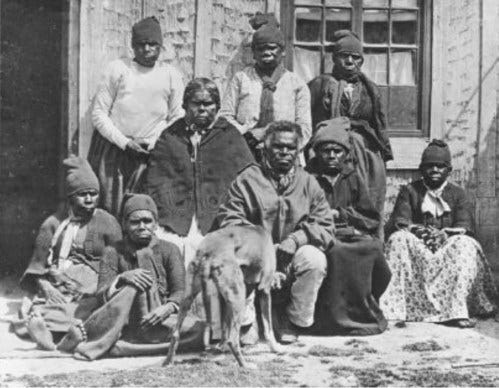
Group portrait, 1860. Top-row, left-to-right: Caroline, Patty, Emma. Bottom-row, left-to-right: Wapperty, Flora, Mary Ann, Jack Allen, Dray, Truganini. ©National Library of Australia, Canberra
The last Aborigine at Oyster Cove was Truganini. She is sometimes mistaken for the last Tasmanian Aborigine – but she’s surely the most famous one, already during her interesting lifetime. Born at Bruny Island in 1812, she had lost her direct family and a fiancé by brutal means before reaching adulthood. Dynamic as she was, Truganini made choices that brought her to quite some places. She was one of the Bruny Island natives that Robinson met in his first mission. In the following years, she joined him on all his missions. When Robinson escaped an attack in September 1832, it was Truganini who saved his life. In 1839, Robinson took her and some other Aborigines from the Wybalenna reservation to the new colony of Port Phillip (now: Melbourne). She was part of a group that attacked some shepherds and killed a couple of whalers. Pevay and Maulboyheenner (the two men in this group) were executed for this; this was the first execution in the brand new city of Melbourne. Truganini and two female companions were sent back again. In her years at Oyster Cove, she initiated seasonal visits to her native Bruny Island. In 1874, she left the Oyster Cove reservation and lived with a befriended family in Hobart. She could be found on Macquarie Street, accompanied by dogs, until she passed away in 1876.
When Truganini passed away, there were no remaining people with memories of pre-colonial trouwunna. Yet, Aborigines never ceased to exist in Tasmania. While she was still alive, Truganini visited Fanny Cochrane Smith, who didn’t live too far from Oyster Cove. Fanny was born (1834) in the Wybalenna reservation and was the last fluent speaker of a native Aboriginal language. In the 1880s, she was recognised as ‘Aboriginal’ by the Tasmanian government. Fanny married a former convict by the name of William Smith, with whom she had eleven children. When I hitch-hiked around the Tasman Peninsula, I was helped by one of their descendants. Thanks! Somewhat more forgotten is Dolly Dalrymple Johnson, the daughter of a sealer and a native woman who’d shot fourteen Aborigines of the North nation to defend her husband… In the 1820s, Dolly was given a piece of land in the village of Perth (TAS), and started quite a family. Besides Fanny and Dolly, the sealer communities in the Bass Strait developed into a creole society, as earlier explained. Let’s fast-forward now. At the time of Truganini’s death in 1874, there were 143 people living on islands in the eastern Bass Strait. By 1881, they were defined as ‘half-castes’ by the Tasmanian government, a terrible term that is racially focused. The community was sent to a new reservation on the nearby Cape Barren Island. This community made a living by catching mutton-birds. The eggs were sold at the markets in Launceston; the birds were heated above a fire whilst oil was pressed out of them. The oil was used for making soap, the rest of the bird was salted and sold at the Launceston markets as well. In earlier decades, even the feathers were sold. Mutton-birding was pretty successful and attracted some white settlers in the area. In the early 1900s, the community had grown to about 200 people. “They were predominantly of British descent; they generally intermarried; they were not homogenous in physical appearance; they had no wish to look as white as possible; the older people liked to return to their place of birth to die; those of lighter colour liked to retain their identity as Aboriginal; they spoke English but retained remnant elements of former Aboriginal languages.”LR In the First World War 21 served in the army, six of whom wouldn’t return. During the Second World War, the population on the island dropped from 300 to 106. Many of the islanders looked for a life in Launceston, Burnie, Devonport, sometimes Hobart or elsewhere. By 1951, the Cape Barren Island Reservation was closed. “In Launceston the Islanders congregated in Invermay, one of the city’s poorer suburbs, where they were often refused service in hotels and suffered discrimination in employment.”LR
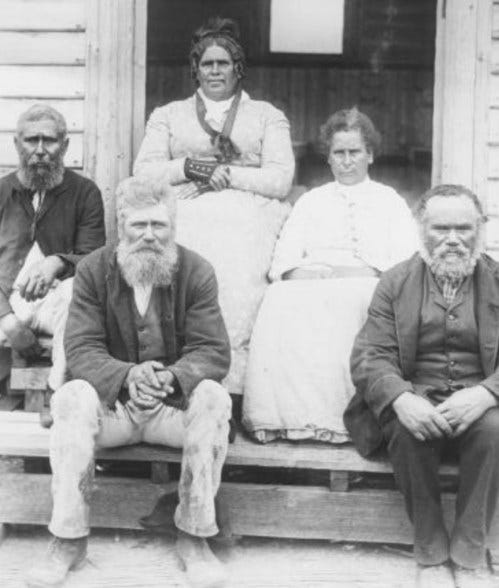
Cape Barren Islaners in 1893. From left to right: Henry Beeton, Philip Thomas, Jane Everett Beeton, Nance Mansell Thomas and John Maynard. ©Tasmanian Archives and Heritage Office, Hobart
In the 1970s, the official policy of assimilation (since the 1830s) changed to one of recognition. Firstly, a nation-wide Aboriginal student organisation took the initiative to organise a conference for islanders at the university in Launceston in 1971. Expecting 200 people, everyone was surprised when 2000 of their people showed up. Two years later in Hobart, the Commonwealth government funded the Aboriginal Information Centre, renamed as the Tasmanian Aboriginal Centre (TAC) in 1977. This centre was successful on some important issues. They secured the return of 34 skulls and three skeletons of their people, or to be more exact, from the ones who lived at Oyster Cove (1847-1874) – including Truganini. Decades earlier, their graves had been disturbed by a medical student, who stole their remains. The Oyster Cove remains were in hands of the Tasmanian Museum and Art Gallery. When the remains were returned, Truganini finally received the funeral ceremony she had wished for. The Bruny Island born woman was cremated 100 years after she passed away, her ashes thrown out over the deepest part of the D’Entrecasteaux Channel. Around the world, mostly in Europe and the USA, the remains of another 220 lutrawita natives were found in museums. Before its return, William Lanne’s body was even on public display at the University of Edinburgh’s School of Anatomy.
Another topic for the TAC was reclaiming land, particularly historic sites, sacred sites and economic sites. The biggest success came in 1995, as an aftermath of the Australia-wide breakthrough in the Mabo-judgement. In several waves, other sites were returned to Aboriginal control – including Risdon Cove. Another topic for the TAC is Aboriginal identity. In an earlier post I mentioned the reconstruction of an Aboriginal language, named palawa kani; but also a framework for recognition of an Aboriginal identity is what is meant here. Nowadays, luckily no governments still defines someone as ‘half-caste’ or not. Instead, and I believe for the best, Aboriginal identity is based on a balance of ancestry, self-identity, and recognition by the community. By this definition, there are many thousands of Aborigines living in Tasmania!
A word after...
Here, I feel we are about to enter the world of now. To say the least, it’s been quite an article about the destructive side of colonialism for native societies. On a political note, the TAC is still active; there are still problems to solve on Tasmania. On a global scale, let’s not forget that violent colonialism has not stopped: most notably (as far as I know) now in Brasil. Every day the Bolsonaro regime is in power, hundreds of thousands of natives in the Amazon are progressively in danger. Let it be a reminder. We have to make a bigger effort for a better future... Like I’ve said a couple of times in the article, there is much more to all of this. I could’ve tried and write more about trouwunna/lutrawita before it was colonised, covering important sites like Kutikina. Perhaps I should have included more interesting life-stories of individual natives, such as Kickerterpoller, Mannalargenna, Umarrah or later, the couple Walter Arthur and Mary-Ann. I could have covered studies of Aboriginal’s huts… The trouwunna/lutrawita civilisation is simply too big to cover in one single blog post. On a more personal note, I wouldn’t have written this if I didn’t had the time of my life (January – March 2020) on trouwunna/lutrawita. Many thanks to Antek (my life-safer in times of Corona!), Rebecca (for a hundred reasons, most relevant: spell checking this article), Helena and Ella for making me familiar with (the Hipsters of) Launceston. For those who are interested in the topic and visiting Launceston, don’t miss out on Sawtooth. Also, thanks for my traveling friends! I tried to think of you as a target-audience for this article (so I basically wrote it for you guys) and I hope I succeeded. So, thanks Yewon, Mathilde, Leo, Bratan Stas and all other friends from the hostel!