
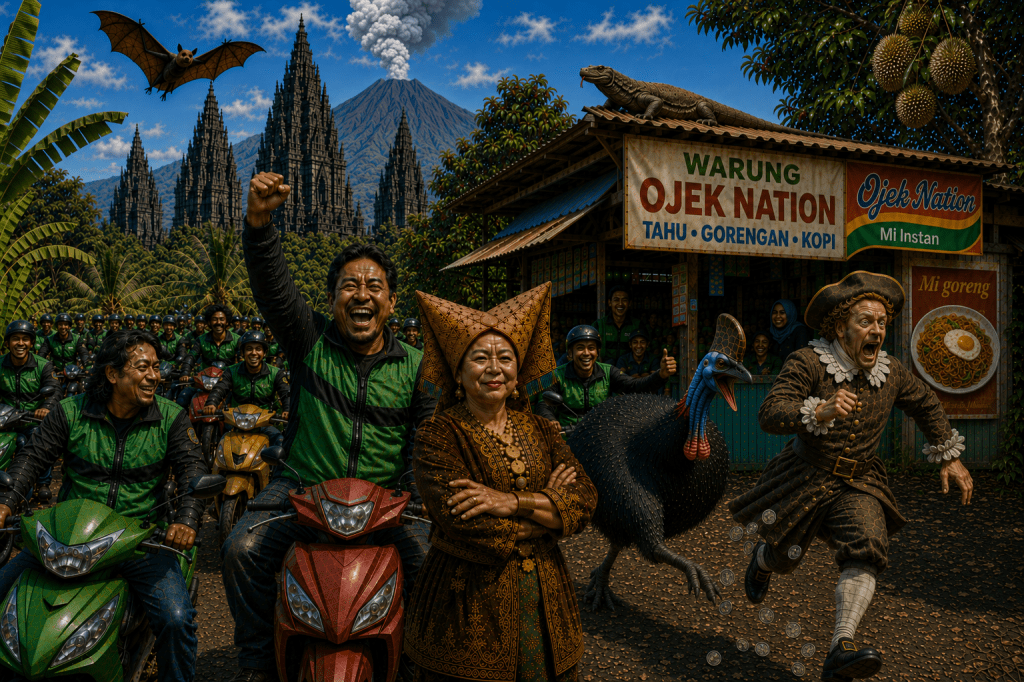
An Introduction to Ojek Nation
This is an ode to the dozens of ojek drivers that made my holidays in Indonesia possible. For the ones who are new to it: ojek is basically the taxi fleet over there. Often with only a moped, the drivers attempt the impossible. At some point, an ojek driver brought me to a museum outside of Yogyakarta. This 35-minute ride costed me €1,70. For the ones who think that this bargain cheers me up: it didn't. It is fucked up. I’m from the Netherlands, aka Holland. And it’s my country that colonized this place in the past. To put it blunt: Dutch wealth is build on Indonesian poverty.1
This bad conscience that comes when I’m confronted with economic inequality leaves me with many questions. Looking for answers, I found historical insights, thought of moral dilemmas and gave me a drive for a more sustainable version of tourism. I think some parts are worth sharing. This absolute masterpiece is the result.
Now, I have to warn you. I don't speak any of the 700+ languages spoken in Indonesia. What I write will be quite limited. And writing about the colonization of Indonesia, still has something Eurocentric about it. There is not much that I can do against it, I'm pretty fly for a white guy. For compensation, I will start with a chapter that introduces the Indonesian culture. From chapter 2 on, we read about the colonization. The following chapters are based on different forms of colonization, in different areas within the archipelago and different periods in history. The Bandas (Moluccas) were occupied by the Dutch in the early 1600s, for the Dutch cuisine could well use some spices. Indonesia’s westernmost area of Aceh (Sumatra) was finally colonized in 1914. Indonesia declared freedom in August 1945, but the Dutch state won’t give it to them without a fight. History did not end with colonisation: the later chapters will discuss Indonesia after 1950. You’ll learn about the highs and lows of ojek nation. This is, by no means, meant to be a complete overview of the colonial history of Indonesia.2 Subjectively, I picked a number of themes that I think are worth sharing and commenting. Hopefully I stayed respectful enough in my mission, although good old sarcasm remains a risky hobby.
Although in honor of the Indonesian taxi fleet, I have to address the Dutch society. We have something to talk about. Unfortunately, I share my nationality with the 'politician' Geert Wilders. His way of dealing with the colonial past is, let’s say, a little wild. In recent years, Dutch officials like the king or the prime minister have actually made apologies towards the Indonesian authorities. Not for the entire colonial project, but for Dutch atrocities during the period in which Indonesia fought for its independence (1945-1949).3 Apologizing ain’t the style of Geert. You could read in his program for the 2025 national elections:
"The Netherlands are a beautiful country. Have a look at our unique landscape, our centuries old mills and our churches. Also look at our rich Dutch history, culture and identity. We want to be collectively proud about our country and who we are - in stead of making excuses for the past of our ancestors. No misplaced culture of shame, but cherishing our traditions, the statues of our national heroes and our celebrations like Christmas, Sinterklaas with a Zwarte Piet and Easter."
Please allow me to elaborate. Dutch culture has an alternative for Santa Claus and his little helpers. It’s Sinterklaas and his helpers: the Zwarte Pieten (‘Black Peters’). When great numbers of black people serve a singular white man, something smells weird. When you have a politician who claims pride in a racist tradition, you know you’ve got a problem.4 4 You hope that such ‘politician’ won't get elected… But he did. I am ashamed to say it, but Geert won the 2025 national election. No shame, no sorry, but statues of our national heroes: "We want to be collectively proud." The Dutch society has a problem. It's nostalgia, mistaking it for history. I am here to show that such a thing is misguided. Have a good read, try and have fun whilst doing so!
Chapter 1. Long Live Indonesia — But What Is It?
How to explain Indonesia? What is the culture? Or I should say: cultures. The country is big, and with this I mean big. Stretching 5.100 kilometers from West to East. The archipelago has somewhat 17.508 islands, depending on your definition of what’s an island. And even depending on the current tide. Anyway, with some 283 million people in 2026, it is now worlds 4th most populated country. So, it speaks for itself that describing Indonesian culture is more than just a paragraph. Let's scratch off a few regions, landscapes and a bit of wildlife.
The Animal Kingdom
Let’s start with a look at the zoo. The archipelago is transcontinental, covering both Asia and Oceania. And it makes a change. Where to draw the line between the two continents, that's up to you my friend. Perhaps, between Bali and Lombok is a good start. The distance between those islands is only 35 kilometers, however, divided by a relatively deep trench. West-side of the trench, 2Pac be chilling at Bali, Lombok is with Biggie. A long time ago, when the global water-levels were much lower than now, Bali was connected by land with the rest of Asia. If tigers and elephants felt like a yoga retreat, they could walk all along. Lombok however, was connected with the Australasian realm. Perhaps it is safer to say, there is no line between the animal kingdom. It's more a transition zone, often called Wallacea.5 1
The funnier animals with pouches are on the east-side. It starts in Lombok with cuscus: small size, furry round-eyed possums that move in slow-motion. After all, the absence of Balinese tigers make them unworried about reaction time. Interestingly, many species of birds behaved accordingly. Cockatoos for example, could well have flown from Lombok to Bali. However, the digital nomad lifestyle just wasn’t theirs. Cockatoos stayed on Lombok. A rule of thump in Wallacea: the further east, the more exotic. Now, sharks already scare me. And I’m of opinion that venomous creatures should not fly. However, God in his infinite wisdom created the Halmahera walking shark and the Moluccan flying snake. Indonesia’s easternmost territory of Papua has cassowaries. These colorful long legged birds five-inch nails and a crest that makes Elvis jealous. The natural born top-models. But careful, don’t feed the models or provoke them, for they will turn into divas. And perhaps I shouldn’t have said “crest and nails” but “casque and claws.” Cassowaries particularly aim for the torso: it’s like they want to steal your heart. And so, these are known to be the most dangerous birds on planet earth. So, I guess I’ll stay with 2Pac.
Watch This: The Moluccas
Did I say Moluccas? I just said Moluccas. Why do you start about the Moluccas?! Let's talk a little more about the Moluccas. It's a region in the east of the archipelago, with Ambon city (on the likewise island) serving as its capital. We are now quite far east and the local cuisine reminds you of it. In stead of rice, sago is used a lot more around here. At the village of Rutong, locals can teach you how to live on sago. It's an intense procedure with artisan technology to turn the plant into a food source. But it works. For the rest, Ambon is known for its music. A stereotype within Indonesia is that the people from Ambon are natural born singers.6 The good thing about Ambon is its perfect bay that serves as a natural harbor. The bad thing about Ambon is its perfect bay that serves as a natural harbor. And so, Ambon became initially the location of the Dutch colonial headquarters. Actually it was not because Ambon itself. The island wasn't the most profitable. Colonizing musicians won't make you rich and sago fills the stomach, not the wallet. It's more that Ambon was located centrally within two other groups of islands: the Bandas further south and the northern Moluccas further to… (have a guess…)
From Ambon island on, I suggest a 250 kilometer swim to the southeast. This is where you'll find the Banda islands. With islands, I mean four islands. On top of the list: Banda Neira and Banda Besar are the bigger, most populated ones. Don't forget about the two smaller islands that played an interesting role in history: Ai and Run. Allow me to add Gunung Api to the list. That’s number 5 but I’m getting away with this. After all, the Gunung Api is not an island, it’s a landmark. The photogenic volcano reaches 640 meters. Gunung Api is not only pretty: it is pretty much seen in the whole wide area.7
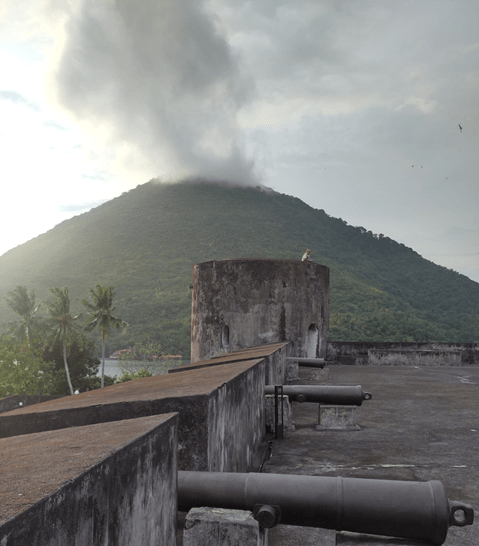
All together, the Bandas are quite something. They are known to be the spice islands so let’s start with that. It is the birthplace of nutmeg and mace, known for giving a warmth, earthy and little bit of a sweet taste. Without stating any brands: nutmeg is a key component in a secret formula for the most consumed fizzy drink. Other spices, like cloves and vanilla, also grow well on the Bandas. Not only flora, also the fauna is impressive. The waters around the Bandas serve as the cruising spot for hammerhead sharks. Whales and dolphins join the party. And the corals, oh, the corals!! The different shapes, sizes and colors are so beautiful. And the coral fishes, oh the fishes!!! I’m sure, the trumpet-fish plays like Miles Davis. Royal angelfish look like blue-yellow striped zebras that found out how to swim. Butterfly-fish could swim faster than whatever Olympic athlete doing the butterfly-stroke. Reef sharks majestically pass by from time to time. And if you’re lucky you snorkel upon a manta ray of some sort. Then there are the parrot-fishes, as tropical and colorful as the birds. Also, they literally have a sharp beak. With this, parrot-fishes eat corals and stone which they cannot digest. The parrot-fish poop it out as sand, up till 1000 pound per year because it’s big fish. If you ever wondered how the Bandas got those pretty white sand beaches, now you know.
In the northern Moluccas, the islands Ternate and Tidore are the most populated. This is where clove trees are native.8 Technically, the cloves are flower buds coming from this tree. The spicy, warm taste is my personal favorite. It’s typically found in speculaas biscuits and also a key ingredient in Indian spiced tea. On Ternate island, you can still look for cengkeh afo (‘old clove tree’) that sprouted in the 17th century. The cengkeh afo lived on against all odds. Dutch colonials fought hard for a monopoly on the spices. It led to a War On Cloves: an attempt to destroy all clove trees, at least the cloves that were not on their plantations. The colonizers punished the production and sale of cloves with others, and not by being tickled. Local Ternateño managed to hide a few clove trees, up in the hills. I have to admit, the cengkeh afo is no more since the early 2000s… but it outlived the Dutch colonizers by far.9
CHECK IT OUT: JAVA
Thanks for making it so far. But. Starting a story about Indonesia in the Moluccas is a little odd. At least, for the people of Java it is. More than half of the Indonesians live on this main island. A bunch of active volcanoes make the Javanese soil very fertile and suitable for the production of rice. In the rice society, farmers depend on each other to keep the irrigation system working. It helps if someone in the society is given authority, often called the raden mas (‘golden lord’). If the production goes well, if logistics and trade are working fine, rice export can pay for a court. And it did. In Asia, rice business went damn well. Surplus explains the construction of temple complexes. Hardly a secret for any tourist, the spectacular temple complexes known as Borobudur and Prambanan (build ±750-850) are proof of economic prosperity. The temples are in the Buddhist and Hindu traditions, although it's worth mentioning that those religions had an overlap – sometimes called Śiva-Buddhism. Once, Śiva-Buddhism was the mainstream in the archipelago. It did not exclude animistic beliefs, local superstitions and a focus on ancestor worship. Minorities of these traditions are still found all around in the archipelago. And the temple complexes aren’t only historical: Borobudur and Prambanan are still in use for active worship by monks and priests.
Somewhat later, in the 14th century, the Majapahit empire reached the peak of its power. From Java on, a local superpower had a sphere of influence that reached even beyond nowadays Indonesia. The current Indonesian flag is based on the flag that this empire once used. Majapahit’s former capital was located at present-day town of Trowulan. Nowadays it’s a capital for archaeologists. The place remains somewhat mysterious, since it used to be a closed city: access was restricted. The capital however, had an impressive water system. The lucky few could even use a public bath.10 At the time, the kolam segaran was Asia’s largest man-made pool. There were huge canals, forever proving that Dutch justifications for colonizing Indonesia "because we introduced infrastructure" is absolute bullocks. Also culturally speaking, Javanese culture was highly refined in the days of the Majapahit empire. Literature reached a peak. Epic poems were performed with wayang puppets, supported with music made by gamalan orchestras.
The Majapahit empire collapsed in the early 16th century. However, with or without the empire, Javanese kings kept living like a prince. Like in the centuries before, the center of their kingdoms were the kraton: a royal palace. This is where the noblemen had a residency, where they governed and where culture gathered. It must’ve been nice to be a prince those days. The rich will be rich and the poor will be poor. Any objections? The people had an answer to it. Like David Van Reybrouck said:
"Javanese feudalism was hierarchical, but (a) new faith required everyone, from nobleman to nobody, to practice humility, kneel five times a day and donate to the poor. In the 15th and 16th centuries, Islam spread by way of Indonesian’s port cities. This was not the result of large-scale immigration, conquest or force; it was the religion’s egalitarian nature that made it so appealing."
And so, the Javanese people had switched from mainly a Śiva-Buddhist religious culture to followers of the prophet.
You Can’t Impress Me
Nowadays, Bali is the only Indonesian island where this Śiva-Buddhist culture is still dominant. Violently colonized by the Dutch in 1906-1908, the smell of gun powder was still in the air when the first upper-class tourists came in 1914. Boosting tourism, the Dutch authorities promoted a romanticized colonial fantasy of Bali as a paradise in the 1920s. In a later chapter, I’ll write more in detail what’s so wrong about that. It won’t stop white people from spending their holidays here. Being the most touristic destination, Bali is probably the island in the archipelago that needs the least elaboration. Let's sing along with the Ozzie band Redgum:
"Wired home for money, short of cash
A dose of Bali belly and a tropical rash
Daddy came through - American Express
Bali t-shirts, magic mushrooms, Redgum bootlegs
And you can't impress me, 'cause I've been to Bali too"
This was in 1984, when Bali had about 750.000 international visitors. Now, it’s about 7 million. Is it safe to say, Bali is a little too touristic.
And the Rest of the Gang
West of Java, there is not much. At least, not much if you forget the world's #6th largest island in the world: Sumatra. Historically, Sumatra has been more in direct contact with the Arab worlds, without a strong court culture that compromised the Islam. Compared to the Javanese, cultures on Sumatra are generally more religiously conservative. At least, at the first sight. Sumatra's westernmost area is called Aceh, which has jinayat or: some version of the sharia law. No barley pop in Aceh. In Aceh, love hurts: khalwat -being alone with someone of the opposite sex- can result in ten strokes with the cane. Affectionate behavior with the same sex will hurt you more. In despite of the jinayat -or probably: because of it- Aceh also has a living punk subculture. Youthful outsiders take humanitarian care to the many unprivileged kids of this rotten world. If you thought punk is dead: in Aceh it's alive. Another Sumatrese culture that I like to point out, is the Minangkabau. It is famous for being a matriarchy. Domestic property is owned by women and passed down the female line. A married Minangkabau man leaves Hotel Mama and moves in with her family. So, Sumatra might be the part of Indonesia that shows off with the Quran. But, don't judge a book by its cover.
Other huge Indonesian islands are Kalimantan, Sulawesi and Papua. In fact, Papua and Kalimantan are world's 2nd and 3rd biggest islands in terms of size, leaving only Greenland before them. Both are partly shared with other nations, though. However, I'll leave it for now. Let me introduce Indonesian Papua when I get to talk about it. Please forgive me for not introducing the other 16.992 Indonesian islands of the archipelago. I think you get it. Indonesia is enormous, its cultures are diverse, interesting… Beautiful. Ojek nation is just beautiful.
Chapter 2. Early-Stage Colonialism of the Archipelago
Alright. Enough with it. No more chit-chat about the nice weather, its tropical landscapes, the richness in flavors and its deep spiritual life. We all came for the bloodshed and let’s get on with it. The colonization of Indonesia. Pardon my French, but… How the fuck did the Dutch fuck up such a beautiful place?
The Portuguese and Other Surround-Sound Info
The Dutch were not the first ones to fuck up the archipelago. The Portuguese were already around. You have to give them credit for once: the Portuguese found sea routes to far away places. Navigating the seven seas, having the stars as your guiding light, mapping coast-lines and learning about currents (sometimes the hard way) is an art in itself. Inevitably, you have to deal with people and the Portuguese did that in their own way. In 1511 they found their way into the Malacca Strait. When the city of Malacca (now: Malaysia) was conquered, many local Muslims were killed or enslaved by the Portuguese. The era of colonization had begun.
One year later, the Portuguese had made their way into the Moluccas. The one who thinks now: “two different letters can’t make a big difference” is mistaken. The Moluccas are about 3500 kilometer further to the East. Portuguese arrived in 1512 at Ternate. This is a kingdom on a volcanic island.
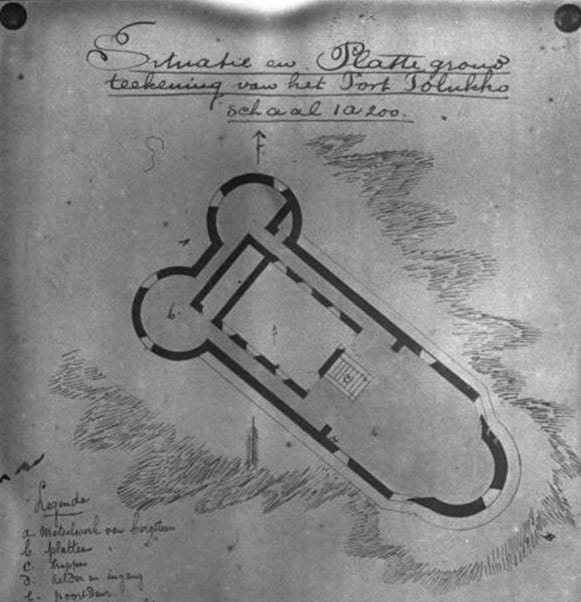
Its sultanate had a long term conflict with its rival, Tidore. The Portuguese must have fainted interest in the local politics, whereas they surely were interested in the cloves. And so, Ternate became the first island with a European fort.11 The message of the fort’s suggestive architecture could not have been misunderstood by the locals.
The Spanish arrived nine years later in the archipelago and naturally sided with Tidore. In stead of throwing Goa parties, the Portuguese and Ternatese, Tidorese and Spanish were throwing mud.12 In 1529, the issue in the Moluccas was solved. Like in the Tordesillas Treaty, that drew a line in the Americas and left the East of that meridian speak Portuguese, the Zaragoza Treaty drew the anti-meridian. It led to a Portuguese dominance in the Moluccas. Further West, the Spanish stayed in the Philippines. It’s an example that whatever happened in Europe, it could have an effect on the people on the other side of the globe.
So, let’s dive a little more into 16th century Europe. Here and then, the pope was challenged by his employees that could actually read a book. Sometimes, versions of Protestantism became a state religion. By 1534, the Anglican Church was established. In the Low Countries, the climax came a bit later. When King Phillip II of Spain kept pushing for Catholicism, it led to the war for Dutch independence (±1568-1648). At first, Dutch and English merchants would do spicy business through Portugal. That changed in 1580, when the Spanish court took over the Portuguese crown. Uniting the Iberian peninsular made that the Dutch looked for alternatives. When the Anglo-Spanish War broke out (1585) the fellow protestants in England joined them in their mission. Cutting of the spice supplies from the Iberian colonies, feeding two birds with one scone.
De Eerste Schipvaart (First Expedition)
We have to talk about Jan. Jan Huygen van Linschoten was quite a character.13 Aged 16, he left Holland for Spain. That is a remarkable choice, since the countries were at war with each other. In Lisbon, he worked as a merchant. When business went down, Jan did what any adolescent with a hang for adventure would do. He set sail for Goa. In 1583, Goa was not quite the place to drop acid on a psytrance beach party. Lacking a decent nightlife, Jan picked up some work for the local archbishop. This is how he got access to maps in the archives from the viceroy in Goa. Now, Jan wasn’t quite the type who was running for employee of the month. He copied the maps of naval routes, some of which were Portuguese state secret for more than a century. Back in Holland, Jan published his stolen travel tips for doing commercial business in India, China, Japan and the Indonesian archipelago. The first book was fresh off the print when one copy was given to the First Expedition to the East Indies.
The First Expedition started in April 1595 with a crew of 249. Unfortunately for anyone involved, Cornelis de Houtman was sent as chief merchant. In an attempt to have a democracy on board, a ship’s council was set up to replace the rule of an admiral. In this council, Cornelis was assigned to be the representative for merchants. Not because of merit, but mostly of a friendly relationship with an influential regent in Amsterdam. Cor’s relationship with the merchants were, how to say it politely, problematic. The voyage went anything but smooth. After 10 weeks, scurvy broke out. After 6 months, the Dutch fleet stopped at Madagascar for three weeks. Thirty-one of the crew died in the following three weeks, among them the captain. In the search for a follow up, one of the merchants had opened an official letter that was clear: Pieter Keyser should be the captain. Pieter had the maps and the skills. Cornelis however, did not let his confidence stand in the way of his incompetence. In an attempt to keep the peace, Pieter stepped back from running as a captain. He was more the nerdy type of guy that would research the stars and constellations in the southern hemisphere and contributed greatly to science. Cor took over control. He locked up the angry merchant who challenged him. When the steersman was killed by the local people, the Dutch swore revenge. A random Malagasy was brought to the site where steersman was killed, just to be brutally retaliated. Another low moment was found when one of the Dutch officials attempted to hijack one of the ships for a piracy business. His initiative was not appreciated by the ship’s council. The Dutchman was left behind on Madagascar, never to be heard from again. But the lowest novelty that came with the Dutch presence at Madagascar is the first enslavement of local people. An adult man drowned during his attempt to break free, but two teenagers were re-captured and forced to stay with the Dutch for several years. Their real names will never be known, but they were given the names Madagascar and Lourens. The somewhat 15-year old Lourens became Cornelis' personal slave. Madagascar, who was about 3 years younger, would serve the rich and mighty Jan Jansz Carel de Jonge. Madagascar would never make it back home, Lourens would never see his wife again.
Finally in the archipelago by June 1596, things did not go well for the first expedition. The sultan from Banten was willing to trade with the Dutch, under conditions that they would help them in a conflict against Palembang (Sumatra). Cornelis de Houtman was not much of a pacifist, but he just came for business. I doubt if he brought the message diplomatically. When the Portuguese told the sultan that the Dutch were basically pirates, Cornelis threatened to burn down the city of Banten. Not so surprisingly, he was arrested with 12 others. The Portuguese fleet could leave Java with a load of pepper. The remaining Dutchmen captured four Portuguese ships and besieged the city, killing hundreds. The Dutch fleet went back to Sumatra for fresh water. They found booze and misbehaved, so they weren’t welcome any longer. The sultan in Banten gave them a second chance. Cornelis and his crew were bought out of prison with a bail bond. Probably feeling pity for the fellow Dutchmen, the sultan traded for a small amount of spices as a consolation price. The Dutch could leave Banten.
Further East, Cornelis found nothing. One party did not want to do business with him, another one attacked the Dutch – killing a dozen. In front of the coast of Madura, the local sultan of Arosbaja was willing to talk. The sultan’s boat, a proa, set sail to the ship Amsterdam instead of the Mauritius. The Dutch panicked, opened fire and killed the Madurese party. Sick and depressed, the Dutch crew refused to go further on their mission to the Moluccas. They needed a break, so they set sail to Bali. The Dutch casually called it Jong Holland because it reminded so much of sunny, volcanic, tropical Holland. Maybe the Dutch felt homesick because it would be their last act in the archipelago. In August 1597, the Dutch fleet arrived back in Old Holland. The spices they bought hardly covered the costs. One ship was lost and only 89 from the original 247 crew made it back. Calling it a success, because at least the way to the archipelago was found, Cornelis commanded the next fleet too. In the summer of 1599, the sultan of Aceh (Sumatra) welcomed the Dutch with all the honors. If the Dutch would join a battle against Johor (Malaysia), a lucrative deal could be arranged. In September, the Dutch were ready for battle. The sultan’s army went on board, bringing with them alcohol and food. It turned out, Cornelis had installed himself some malware. The drinks were spiked, most likely with datura that causes an instant bad-trip. Together with Cornelis, more than 100 Dutch crewmen drowned, were killed or enslaved. The route to the archipelago was found, but the Dutch cuisine was left behind (nearly) as bland as before.14
VOC: A Capitalist’s Wet Dream
Cornelis de Houtman proved that even an idiot can find the way to the Indonesian archipelago. Between 1595 and 1602, the Dutch sent 65 ships to the archipelago, 50 even returned. This success turned into a problem: the prices for spices were going down. The Dutch cities and provinces competed a little too hard with another. In an attempt to keep up the profits, six companies merged together into the Vereenigde Oostindische Compagnie (‘United East-Indian Company’) or in short: the VOC. The Dutch parliament granted superpowers to this private enterprise. For example, the VOC was allowed to sign diplomatic agreements. For pushing a good deal, it was granted a military force. There were no legal worries: the VOC did its own administration of justice. And as the cherry on the top: it even introduced its own currency. The Dutch parliament gave the VOC all these powers under one condition: to annoy the Portuguese and Spanish as much as they could.15 And there was one more novelty. The Dutch people could buy shares and stocks on a public market. And people did. When it was established in 1602, not only the usual suspects like merchants, but also doctors, preacher-men and people from the labor-class bought stocks in the VOC. Back in Holland, the VOC was led by Heren XVII: a group of seventeen chairmen. For the overseas territories, the Heren XVII appointed someone to be the general governor.16 Blending purest forms capitalism, competition and colonialism… What could possibly go wrong?
The Banda Islands: nutmeg and bloodshed
The setting for the next soap-opera will be the Banda Islands. As mentioned in the first chapter, the spice islands are mainly four. The bigger, more populated ones are Banda Neira and Banda Besar. The underdogs being Ai and Run. Around 1600, the Anglo-Dutch relations were still fine. Being protestant nations with a common Spanish enemy, it created a bond. Throughout the 17th century, this friendship between the two protestant nations would suffer a lot from something I'd call Dutch Religion, better known as: money.
The English found the way to Run island by 1603. A little post was built, but proper trade with the Europeans did not take off yet. Six years later, captain William Keeling had a successful mission on islands Ai and Run. The locals were interested in trading nutmeg and mace with the English, since they could give cotton in return. That was something the Dutch couldn’t. And when the locals prefer taking part in the English imperial project over yours, you really look like a fool. The Dutch did not take that too well. The VOC-fleet from Pieter Verhoeff set sail for the Bandas, to end English trade. In a crazy turn of events, poor Pieter ended up being the one that is ambushed and killed by the local people. On Ai island, VOC-staff feared for their lives, but in an act of chivalry were protected by Captain Keeling. On the islands Banda Neira and Banda Besar, the Dutch got what they wanted. In the early 1610s, they made a deal with the local population to have the monopoly of trade in spices. The locals were not too happy, since the Dutch paid less than the English. That's partly because the English did not build expensive forts that had to be manned. Fort Nassau (1609) and Fort Belgica (1611) on Banda Neira and Fort Hollandia (1624) on Banda Besar. That is three forts within two miles. Go figure. It had cost the Dutch more than a dollar but well, it's not them who paid.
In May 1615, the island of Ai was besieged by the Dutch. General governor Gerard Reynst made quite a mess. Stack houses with spices and rice caught fire, the wind blew the smoke back towards the Dutch. Gerard Reynst called it a day and retreated. Before entering his ship Neptune his men were slaughtered at the beach. It took the VOC about 200 lives. Finally, at the safety of his ship, good old Gerard dared to call it a success. The next year, the Dutch commander by the name of Jan Dircksz Lam had orders to conquer Ai again. Luckily for him, Samuel Casteleton was leading the English fleet. Sam was saved by Jan Dircksz three years before, when a Portugese surprise at St. Helena nearly took him out. Samuel refused to fight his savior. A deal was made: the English could stay at Run, one English merchant would stay active on Ai. For the ones who would say “That's a gentleman's deal” I have to remind you, for the local people of Ai it was a nightmare. They fled en masse to Run and Banda Besar. Poor weather and rough sea took about 400 lives. How the ones felt that survived is written in a letter to the English settlement in Banten (Java), calling the Dutch "sons of whores."
Sam's idea wasn't received all that well on Run island either. For the next whooping 1540+ days, the island was blockaded by the Dutch VOC. On Run, hardly any rice is produced and a nutmeg-diet does not compensate. Things only came to an end in 1620. That’s when Nathaniel Courthope, the English commander on Run, heard about a possible uprising against the Dutch on Banda Besar. Setting sail in a pirogue, he was intercepted by the Dutch war-ship. Wounded in battle, Nat jumped in the ocean. Run was occupied by the Dutch. With a “back to the Stone Age” strategy, the Dutch destroyed nutmeg trees and replaced it with by cattle so that the English wouldn't think about taking Run again.17 And with Nathaniel turned into fish food, the local people on Banda Besar lost a potential protector. In the following years, they could well have used one…Within the Dutch VOC, Jan Pieterszoon ('JP') Coen made it to be general governor of the VOC. JP Coen had studied about 6 languages and accountancy. In theory he was a supporter of free trade. However, Machiavelli was the foundation of his moral compass. It led him to writing a business plan for the VOC. Let me summarize it for you: “let's have it all.” His moment of fame came in 1621. With force, the VOC took control of Banda Besar. This is an island that actually had something like an army. It resulted in a treaty with the local aristocrats. The VOC would have the monopoly on spice-trade, in return the local people and culture were to be treated with respect. A local ruler and a Dutch commander made a pinky promise. They cut their finger, shook hands and let the drops fall on a rock.
Little did they know. The local people had already started a guerrilla. And the VOC retaliated on the worst possible scale. About 100 Bandanese people were killed in battle, around the 2500 died of starvation and diseases. An unknown number killed themselves, for example by jumping off the cliffs. About 1700 were enslaved and brought to build up VOC's new capital on Java that was called Jakarta. A few Bandanese people were brought back to Banda Besar for the know-how of nutmeg cultivation. Let that sink in for a while… The total number of casualties is not really known. New academics say 4500-5000, older numbers go as high as 15.000. Nowadays, there is a word for this: genocide. The thousands that were killed, were mostly replaced by enslaved people. The VOC bought and transported 1167 people from India to the archipelago, most of them still children. Twenty percent of them did not survive the deportation. It was the first time the VOC traded and transported enslaved people, with many more to follow…
Dutch-Anglo relations
In the following decades, the diplomacy between the English and Dutch deserve an award winning telenovela.18 In the year 1623, 10 Englishmen working for the EIC and some 10 others were killed by the VOC court in the Moluccas. The reason was a potential coup against the Dutch, but evidence was flimsy. With this I mean that some of the evidence was fabricated by waterboarding and other methods of torture. The English vox populi was not amused. For decades, the memory was kept alive. Cromwell used the feelings of injustice around the Amboyna Massacre as a justification for the First Anglo-Dutch War (1652-1654) that the English won. In name of justice, the Treaty of Westminster demanded a punishment for the Dutch judges during the Amboyna trials. At that time, none of them were still alive. Another article in the peace treaty demanded the return of Run island to the English. By then, Run was used by the Dutch for 34 years. Actually, in 1638 the English tried to control Run but they were fought off. Ever since, the Dutch did an annual check on Run whether for traces of tea and biscuits. The English however, wouldn't show up to Run before the Second Anglo-Dutch War. The VOC fought them off and eventually won that war. In the Treaty of Breda, Run was finally claimed by the Dutch. In return, the English could keep a swampy settlement that they had conquered on the east coast of the Americas. Initially it was named Nieuw Holland, but it has been called New York ever since. Basically, the most expensive square meters nowadays were traded for a tropical island with some nutmeg trees.19 That is: if the Dutch had not destroyed them in the early 1620s.
Collective Pride? Alternatives?
Who doesn’t like to check the street-cred of historical figures? Cornelis de Houtman gives name to quite some nice places throughout the Netherlands. In his hometown Gouda, he has a waterway, a path and public garden named after him. In The Hague and Arnhem, he has a street. In Amsterdam, he is mostly remembered by the quay in the Zeeheldenbuurt (‘the hood for heroes of the seas’). A hero? When it comes to Cornelis, I admit he had an element of existential sacrifice. But I think he paid with his life because of incompetence, not out of heroic altruism. And then, there is Jan Pieterszoon Coen. About 28 streets in the Netherlands are named after a mass murderer. An important tunnel connecting Amsterdam with the peninsular further north is named after him. A fancy statue on a stage honors JP Coen in his hometown of Hoorn. Let it be exemplary: history is written by the victors.
Alright, so much for nitwits and psychopaths. Before this turns into a rant about Dutch failures and poor morality, here are some alternative stories. A more positive example would be the fleet commanded by Jacob van Neck, who traveled twice in the period 1598-1602. Although he was confronted with the bad reputation that Cornelis de Houtman and his crew left behind, Van Neck managed to sail his way through the archipelago. Diplomatic success in Banten (Java) brought shiploads of spices to the Netherlands. Like a gentlemen should, mister Van Neck showed compassion with Portuguese prisoners in the archipelago. He gave them food and some of his personal money. Not so noble -colonial after all- Jacob went to battle with the Iberians. However, he called it a day to minimize the number of casualties among his crew. In Patani (now: Thailand, bordering Malaysia) Jake started a trade post, speaking honorably about the local ruler who paid them a visit. Although Jacob van Neck had plenty of hardship during the voyages, the survival-rate was a whole lot higher. On his first trip, only 15 out of his 550+ crew did not return. You can’t really celebrate a death toll of 2.7% but still… It makes Cornelis de Houtman, leading a fleet that lost 74% of his crew before being drugged to death, look like a suicide pact.20 10
An alternative for JP Coen was possible when Laurens Reael, who governed before Coen, was in office from 1616-1619. On the Bandas, Laurens was willing to let Chinese and English parties have a cut in the spice trade. However, Laurry had conflicts about the price that should be paid for nutmeg. Not with the Chinese, the English or the local people; but with rising star JP Coen. At first, the Heren XVII of the VOC thought Reael was too weak as a general governor, later complaining that JP Coen was too aggressive. The chairmen in Holland said they weren't pleased with JP Coen’s murderous act, but they saw the profits rise and turned a blind eye.
So, yes. There always have been alternative ways of trading in the archipelago. But I don’t think that is representative. It is safe to say that the Dutch colonial project started with enslavement, espionage and thievery. Sometimes there was poor diplomacy and a lack of trading skills. What there always was: violence. I don’t take collective pride in times when Holland ruled the waves. And the people of Indonesia would have been better off if we hadn't.
Notes
Ofcourse, there is a discussion about this. After all, economy is not a zero-sum game: the export of Indonesian value could've been changed for European know-how, infrastructure and other things. But in the colonial times, I think it didn't. Colonialism was primarily there for the economic benefit of the Dutch colonizer. And that became particularly clear during in 1949, while discussing the terms and condicitions for which the Dutch state would acknowledge Indonesian souvereignity. The Dutch state demanded 4.5 billion guilders (now: €24,5 billion). Nearly 4 billion was paid from 1950-56: a period in which the war-thorn Dutch society needed a capital investment for the 'wederopbouw' (reconstruction). The Indonesians could have used that money themselves as well. The last transfer from the Indonesian state towards the Netherlands took place in 2002.
Most of the research is done by journalists and scientists. In terms of inspiration, I want to thank David Van Reybrouck, a Belgian journalist. His book Revolusi is phenomenal. In this, Indonesian people are given a voice. The original version in the Dutch language was published in 2020, English versions date from 2024. How would it be to have this translated in the Indonesian language? Next: I'd also like to give credit to David Hunt, who wrote hilarious books about Australian history.
For example, king Willem-Alexander gave a speech in Indonesia: “I would like to express my regret and apologize for excessive violence on the part of the Dutch in those years. I do so in the full realization that the pain and sorrow of the families affected continue to be felt today.” Or prime-minister Mark Rutte: “I make a deep apology to the people of Indonesia today for the systematic and widespread extreme violence by the Dutch side in those years and the consistent looking away by previous cabinets.” Neither Mark Rutte nor the Dutch royal house are exactly woke hippies.
Surely, Sinterklaas has been celebrated since the 17th century, the fictional figure of Zwarte Piet was added in the later 19th century. The figure of Zwarte Piet is invented tradition and not the fucking constitution. Talking about the Dutch constitution, Geert Wilders expressed his wish to abolish §1: “Article 1. All persons in the Netherlands shall be treated equally in equal circumstances. Discrimination on the grounds of religion, belief, political opinion, race or sex, disability, sexual orientation or on any other grounds whatsoever shall not be permitted.” Call me a soy boy, but I would rather keep this one.
Named after Alfred R. Wallace, the scientist who found out, observed and understood this change in fauna. Academics ever since looked where ‘the line’ exactly was, giving names to the Weber Line and the Lydekker Line. Wallace’s contributions were inspirations for another biologist: Charles R. Darwin.
I found proof for the stereotype when I passed a loud karaoke-party. It was 10am.
Now that we are here. Let’s get on with it. There are more islands in the Bandas, just to be mentioned quickly. Hatta island plays a smaller role in history than the others, but is a snorkeling hotspot. Just to be complete the list, the smallest island is called Pulau Pisang (Banana island). I haven’t been there, so I don’t know what it’s known for. Even smaller is Nailaka, next to Run. The uninhabited island is more often mentioned than something really happening there.
Technically, clove trees also grow on islands Makian, Moti and Bacan.
Still, it’s worth going to the place where cengkeh afo was. The pleasant spicy smell isn't the old rocker itself any more, but its younger siblings. Those clove trees are too young for the War On Cloves, but are old enough to be called living history.
At Candi Tikus, which translates as ‘rat temple’ because it was heavily infested when it was re-discovered in the early 20th century.
To be fair, there are 2 forts build at Ternate around the same time (1522). The first one being Fort Kastela. The fort with the suggestive shape is called Fort Tolukko.
Who am I kidding. The conquest of Goa (1510) was brutal. It killed 6000 Turkish mercenaries. The Portuguese officer Albuquerque wrote to the Portuguese king: “I burned down the city. For four days, your men were shedding blood. Wherever we found them, we did not spare any muslim. We filled the mosques with their bodies and burned those down.” Just saying.
Actually he was called Jan Huygen, he added ‘van Linschoten’ during his time in Goa. Nothing wrong with a nom de guerre but no one knows why he chose it.
Meantime, another fleet was sent towards Indonesia. The ships had positive names like Hoop (Hope), Liefde (Love), Geloof (Faith), Trouw (Fidelity) and de Blijde Boodschap (the Happy Message). Using the Magelan Strait, this optimism turned out a bit presumptuous. De Blijde Boodschap was captured by the Spanish, Hoop sank in a storm, Geloof went back to Holland. Liefde made its way to Japan, a voyage that wasn’t profitable. Only Trouw made it to the archipelago, where it was occupied by the Portuguese. Six of its crew was saved, the rest was killed.
Annoying the Iberians is an ongoing tradition during moments of national pride. For example in the world-cup football 2006, when a Portuguese-Dutch match led to a new FIFA-record: 16 yellow cards and 4 red ones. The game is nicknamed The Battle of Nuremberg. The Dutch-Spanish match in 2010 was not too bad either: 14 yellow cards, one red. I don’t think Dutch football culture has anger issues, not at all.
A bit more exactly, the function of general governor started in 1610. From 1619 on, the general governor resided in Jakarta. The function was to be appointed by the Heren XVII.
Arguably the 17th century version of the Morgenthau plan.
In the English language, this centuries old rivalry had made its impact. Going Dutch is splitting a bill, stereotyping our stinginess. A little more gross is a Dutch oven, which is the chaleur of a fart underneath a blanket. Dutch courage is braveness after the consumption of alcohol. When you speak gibberish, it’s called double Dutch.
Personally, I think the Dutch made the right choice here. I prefer the natural rain-forest and coral sea over the stressed metropolis with a Trump tower.
Truth be told: not all of the 158 people in the first fleet died under Cornelis de Houtman’s command.